
What We Owe
a quick one about drums and meaning

Back in May of this year, Aaron Steele shared the following on his instagram story:
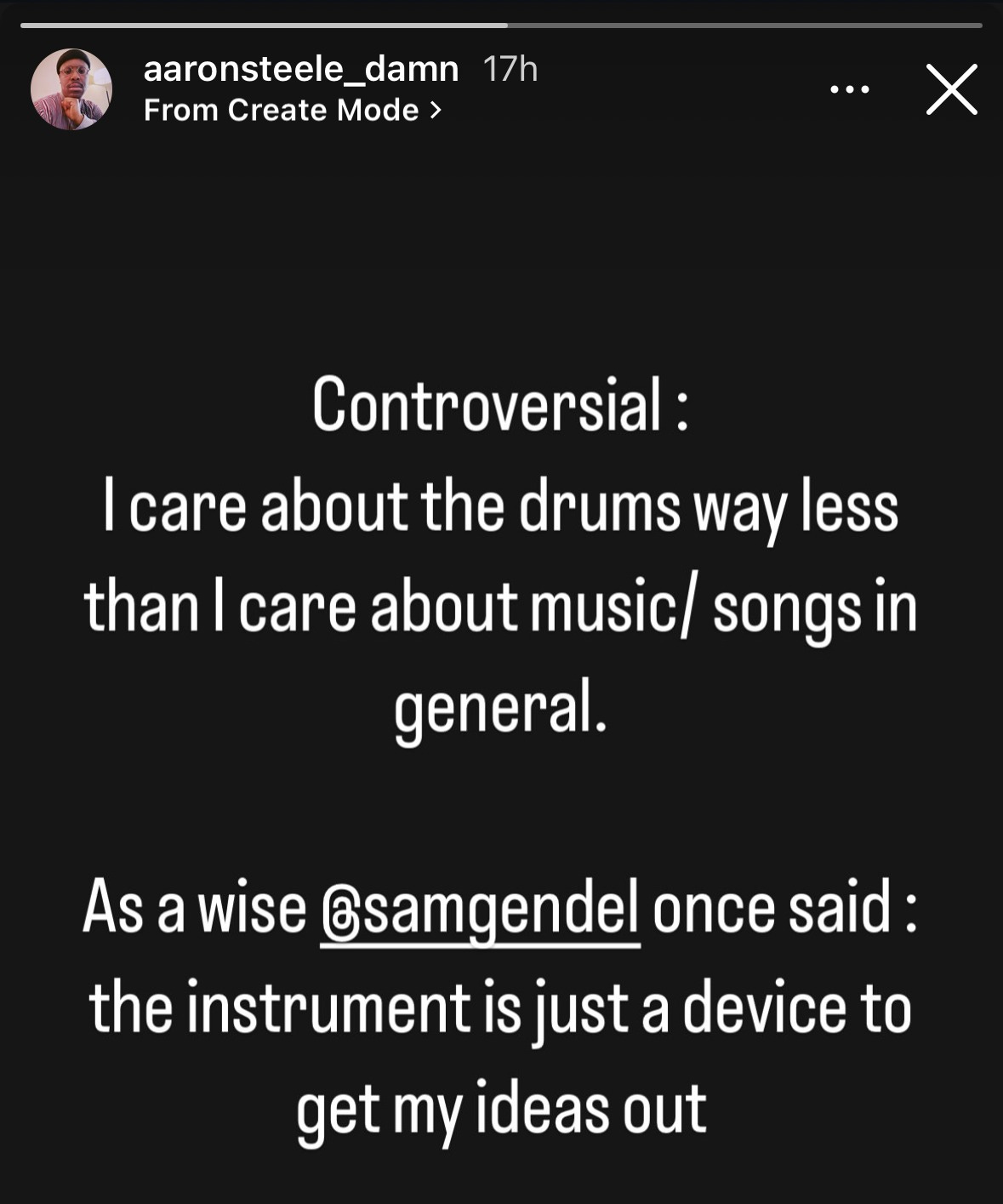
I can’t remember where I first encountered Steele’s playing, but I remember being a fan right away. He appears to love vintage drum tones, we both play Istanbul Agop cymbals, and he plays in all kinds of musical settings. I knew about him mostly from the studio/groove/singer songwriter realm, but was pleasantly surprised to hear him on some of Joshua Johnson’s music most recently. I like his improvised stuff too!
Anyway, when I saw his statement about drums on his ig story I remember feeling a few things at once: Hell yeah, man! It’s all about the soonggggs, and wait, are you saying you don’t really practice? What if you need to improvise and communicate clearly on a song you’ve never heard? Of course Steele didn’t say he doesn’t care about the drums at all. He just cares about them less than the song. But then, is a song only as good as the performance of the musicians? What happens if the musicians are not in constant pursuit of improving on their instruments? Does the song suffer? Or does the potential for impact diminish once a listener notices a lack of depth within the musicians’ sound? I think the answer to most of these questions is no. A very not so great drummer can write the perfect drum part for a song and it can go on to be a smash hit.
What I am wrestling with here, honestly, is whether or not drummers are called to something ‘higher.’ We could maybe insert any other instrument here, but a certain sort of conviction is rumbling inside of me that is specific to the drums. What if drummers don’t have the privilege to care less about the drums than the song? Free will blah blah blah, obviously, but what if? A hobbyist is a hobbyist, but what about those that feel particularly called to the instrument? Let us all consider the removal of the drums and dancing from the antebellum south. Luther Gray says “It was illegal to play drums, keep your African name, speak an African language, do any of the dances or practice your religion.” Making an enemy of the drums as Joe Chambers puts it regarding the eventual quieting of the drum in Congo Square. The history of the drums, especially in the USA, almost forces us to approach the instrument with a certain amount of reverence.
Art Taylor asked Elvin Jones in an interview once “Were you influenced by anyone when you started playing?” Jones replied: “Yes. I was influenced by the bandleader at my school. He had all the integrity and dignity of what I really believed in and still do. I listened to Kenny Clarke a lot and Max Roach, Chick Webb, Jo Jones, Baby Dodds. Cats like that. I used to listen to all kinds of parade drummers and circus bands, the American Legion Drum Corps. All these things influenced my early development because it made me aware of the importance of the instrument.” Drums call out. Drums organize. Drums dance. Drums sing. Drums swing. Drums are important!
Check out this recording of Baby Dodds just grooving on his toms. It’s a simple thing but it is all there, rhythm and melody. It’s straight but swinging, too. Whew! The drum set was basically a brand new instrument in the 1920s. If you check out the rest of those recordings you can hear Dodds’ love of the instrument really come through. Fast forward to 2025 and you have people like Eric Harland out here still finding new ways to explore the instrument. Multiple hi hats and a double bass pedal in ‘jazz’??
At one point in that video Harland speaks to the importance of groove and improvisation. “If the groove hits, then do the groove, but if it’s kind of lucid for a minute that’s also beautiful as well.” Lucid roughly meaning being able to dance on top of the groove, make things a bit more loose and bright. A different kind of clarity. Playing solid time/groove while coloring on top when necessary I think is not something that can be developed when caring less about drums than songs. The respect for both has to be almost even, I think. Later, Harland says “I love some groove, but I love when the groove is honest.” To speak honestly through the drums in a performance or recording requires an honest pursuit of the drums.
-
Jack DeJohnette just passed away on Oct. 26th. I had this little essay in drafts before that, but his passing really pushed some of these ideas to the front of my mind. Joe Chambers credits Max Roach and Kenny Clarke with liberating the drums in the bebop era in the USA. DeJohnette, Chambers himself, Elvin Jones, Roy Haynes, Art Blakey, and Tony Williams just to name a few were some of the drummers that pushed the drums to the forefront soon after. To be a drummer is to be convicted by the history of the instrument and to push forward accordingly. Not to copy cat, but to push. I think this is what we owe the people who came before us on this instrument, at the very least.
Kassa Overall shared this small tribute to DeJohnette the other day:
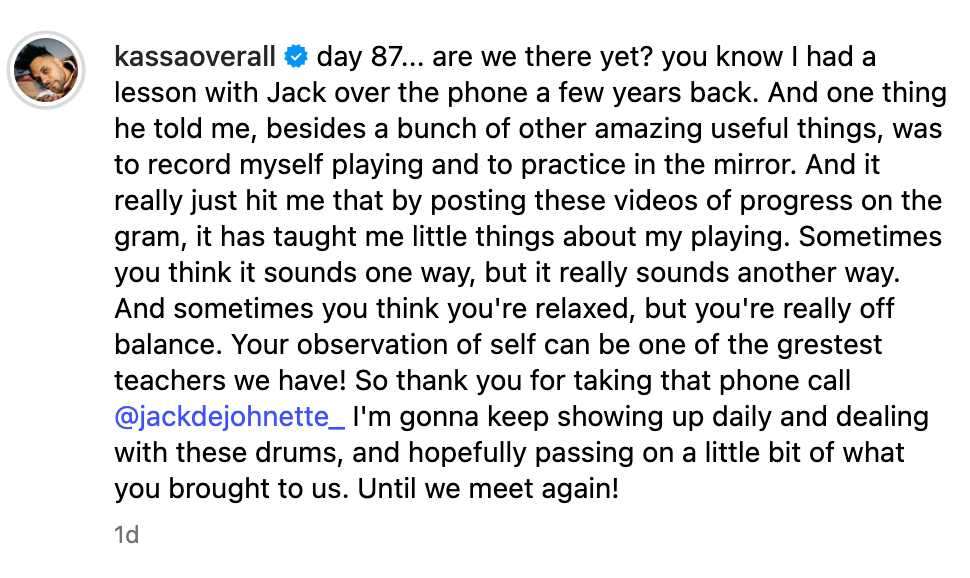
show up daily and deal with these drums!
okay, here’s a coffee recipe
22g coffee, medium coarse
origami dripper (or whatever dripper you want/use daily) and one paper filter
boil some water in your kettle, then let it sit for a bit. maybe a minute.
first pour - bloom: pour to 80g
at 45 seconds pour to 120 g
then 180 g
then 240 g
then to 320 g
then finally to 352
this is a 1/16 ratio and should end around 3 minutes and 30 seconds. try it out!
—
*If Aaron Steele sees this please know I’m not trying to cook you with this lol. Your body of work speaks for itself. Thanks for being a launching pad for my little ideas here.
i think caring more about the song overall makes anybody’s part in it as best it can be. 🤘🏽💙🌊